
Milestone · October 7, 2026
Truck Energy launches its own work order and warehouse system
Since Monday 5 October, every motor that comes into the workshop has a work order with a status, and the warehouse only charges material to it while it is in progress. The team built the system in-house, together with its programmer, to meet internal needs.
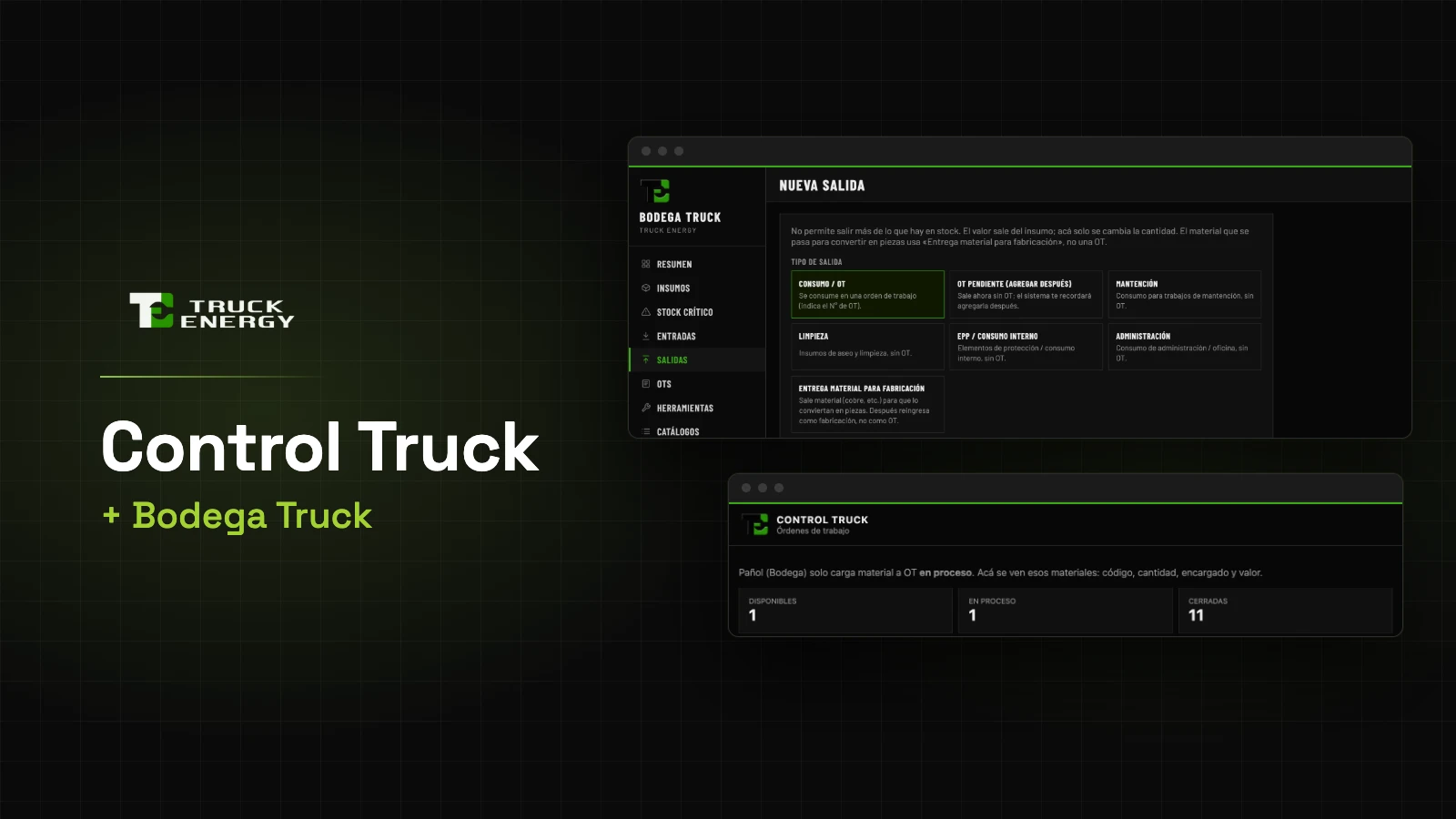
Since Monday 5 October, Truck Energy has officially been using its own control and traceability system for its work orders and its warehouse. It is not off-the-shelf software: the team built it in-house, together with its programmer, to meet internal needs. It was announced to every department the week before, and it has two parts: Control Truck, for work orders, and Bodega Truck, for supplies, receipts and issues.
The fundamental change is that a work order is no longer just a number written on an issue slip. It now has a status (available, in progress or closed), and the warehouse can only charge material to it while it is in progress. That way the cost of repairing a motor doesn't get mixed up with cleaning, the office or other departmental use. It is a big change in day-to-day work, because it directly touches every one of the company's operating processes.
How a work order moves:
- It is created with its number and the motor's model and serial, and becomes available.
- It moves to in progress when the workshop actually takes it on. From then on it can receive material.
- It receives material. The tool store issues only to orders in progress, and every issue is recorded: what went out, how much, who collected it and at what value.
- It is closed when the motor is delivered, and no longer accepts charges.
- If the motor comes back, the same order is reopened. A warranty claim or rework doesn't create a new order: the original is reopened, and everything already issued stays in its history.
The warehouse sorts out its side too. Every issue states what the item went out for: if it is for a motor, it goes to that motor's work order; if it is for maintenance, cleaning, personal protection, the office or making parts, it goes out under that type and not against a made-up order. Receipts are told apart in the same way, so a purchase isn't mixed up with a return or an adjustment, and when something comes in at a different price, the stock value is updated with the average.
Old work orders are not carried over. A work order used to have no status, so there is no way of knowing which of the old ones are still live: if the store could pick any of them, the list would be huge and material could be charged to jobs already delivered. That is why only orders in progress can be used, and finished ones are being closed so the list gets shorter.
The result shows in every order: number, model, serial, status and all the material charged to it. With that, the cost of each repair can be checked against what actually left the warehouse.
The rules the system runs on are set out in the work order control procedure (P-19-02), published in Spanish in La Biblioteca at the end of September.